
Build a Five-Address St. Augustine Housing Shortlist That Survives Real Life |
A useful housing shortlist compares addresses, not listing photos. Five carefully researched candidates are enough to expose the tradeoffs in jurisdiction, daily travel, flood and insurance information, taxes, services, maintenance, and future flexibility. |
 A Florida boardwalk is a reminder that the life around an address matters as much as the rooms inside it. |
Limit the list so research can go deepA search portal can return hundreds of homes and leave you with little understanding. Choose five serious candidates that meet the same basic constraints: price ceiling, minimum space, required home function, and an acceptable broad travel area. They need not be identical, but they must solve the same household problem. Put each property in its own row in one worksheet, and keep the evidence source beside every score.
Column one: identity and jurisdictionRecord the full address, parcel number, legal description, year built, lot size, housing type, and governing municipality. Search the exact address in the St. Johns County GIS iMap. Confirm whether it is inside the City of St. Augustine, inside the separate City of St. Augustine Beach, or in unincorporated St. Johns County. This determines the correct permit, planning, code, road, parking, trash, and other contacts. A “St. Augustine” postal address does not settle the question.
Column two: the ordinary weekdayList the seven trips the household repeats most: work, school, childcare, healthcare, groceries, family care, and the activity that makes the location worthwhile. Test them at the hours they occur. Record total weekly driving, bridge dependence, parking, safe walking or cycling options, and the availability of needed services. A home that saves money but requires another vehicle or ten extra hours of driving has a housing cost the listing does not display.
Column three: purchaser taxes and fixed chargesUse the parcel and a realistic purchase value in the St. Johns County Property Appraiser tax estimator. Record the estimated ad valorem tax and non-ad valorem assessments separately. Then add association dues, condominium fees, special assessments, private-road obligations, parking, storage, and mandatory amenities. Do not use the seller’s current bill as the purchaser estimate; ownership changes can remove exemptions and caps.
Column four: insurance, flood, and evacuation factsObtain an address-specific insurance quote using accurate roof, construction, opening-protection, occupancy, and loss information. Record premiums, deductibles, required inspections, exclusions, and separate flood coverage. Use the county Floodplain Management resources for flood-zone and elevation-certificate information and the GIS evacuation layer for planning. These tools answer different questions: a flood map describes regulatory risk information, an evacuation zone supports emergency planning, and an insurer prices a policy. Do not collapse them into one yes-or-no score.
Column five: physical condition and maintenanceFor each address, note roof, exterior, windows and doors, heating and cooling, plumbing, electrical, drainage, trees, pests, seawall or dock, pool, irrigation, and association-maintained components. During a serious purchase, replace observations with an independent inspection and specialist opinions. The Consumer Financial Protection Bureau distinguishes inspection from appraisal and recommends scheduling the inspection promptly. Translate each material finding into timing and a local estimate.
Column six: permits, records, and rulesRetrieve permit history from the correct government. The City of St. Augustine, St. Augustine Beach, and St. Johns County maintain separate building processes. Search deeds, restrictions, easements, and other recorded documents through the St. Johns County Clerk. For an association, review the declaration, bylaws, rules, budget, reserves, insurance, meeting minutes, assessments, and litigation. Mark every verbal answer that still needs documentation.
Column seven: services and setupIdentify the actual electric, water, wastewater or septic, solid-waste, internet, gas or propane, irrigation, and emergency-service arrangements. Ask for recent utility bills when available, but adjust for household size and habits. For rural candidates, record well, septic, private-road, broadband, fuel, and tree responsibilities. For coastal candidates, add salt exposure, storm shutter or opening-protection work, sand, parking, and evacuation preparation. For historic candidates, add alteration-review and older-system considerations.
|
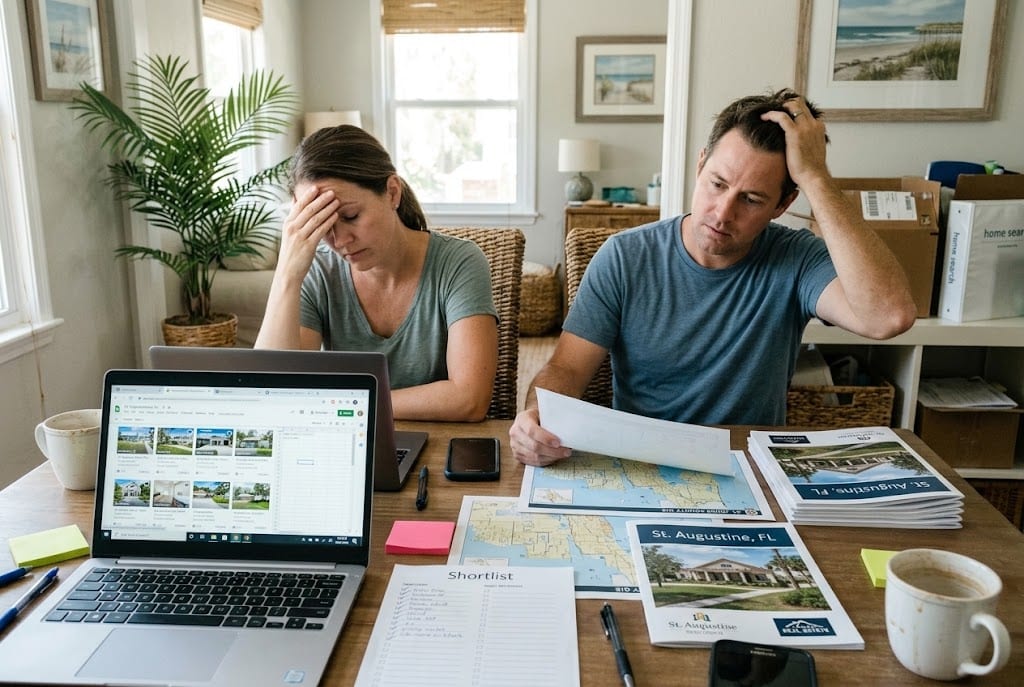 The work effort can seem daunting and foreboding. However, the payoff is a much better understanding of the options and the available alternatives, without the reflection of emotion. |
Score evidence, not emotionUse one-to-five scores for weekly access, total monthly cost, cash required in year one, maintenance load, risk preparation, home function, and future flexibility. Weight the categories before the second visit. A source-supported score receives full confidence; an estimate receives half confidence; an unanswered question receives zero confidence even if the expected answer is favorable. This prevents a beautiful but under-researched home from winning by default.
Create a veto list before rankingVetoes are conditions that end the comparison: an unworkable commute, insurance outside the ceiling, a prohibited essential use, unresolved access, an unsafe system, an unsupported addition, an association assessment beyond the reserve, or cash needs that erase the emergency fund. Keep the list short and measurable. A veto is not a dislike; it is a household limit established before attachment.
Visit twice with different assignmentsOn the first visit, test function: rooms, storage, stairs, parking, outdoor space, noise, and maintenance access. On the second, test context: morning or evening traffic, rain and drainage when available, neighborhood activity, lighting, service routes, and the trip to the most-used destination. One partner can evaluate the home while the other records the surrounding routine, then switch. Do not trespass or rely on a single quiet showing window.
Make the final comparison readableReduce the worksheet to one page per address plus a single summary table. Highlight the two strongest documented advantages, the two highest costs or risks, every unresolved item, and the first-year cash estimate. Rank only after missing evidence is visible. The winner should not merely have the highest score; it should have the best-supported score and no triggered veto.
Hold a decision meeting without listings openClose the listing tabs and review only the evidence sheets. Each decision-maker names the strongest documented advantage, the largest unresolved risk, and the assumption most likely to be wrong. Resolve disagreements by identifying the missing document, route test, quote, inspection, or professional opinion—not by repeating preferences. If two addresses remain close, compare the downside case: which one is easier to carry, repair, rent, or sell if the household’s plan changes? The exercise reduces the influence of photography, staged rooms, and deadline pressure. |
 The successful conclusion resulting from the work comparing five addresses before choosing the home behind the keys. |
Archive the rejected evidenceKeep the completed sheets for rejected homes until the search ends. They reveal recurring costs, common inspection issues, realistic travel times, and the reasons the household’s priorities changed. That record prevents the same unsuitable feature from returning in a different listing and gives future estimates a local baseline. It also makes a later decision easier to explain: the chosen home did not win because it was perfect; it won because its tradeoffs were documented, affordable, and acceptable.
What single address-level test would you add to this scorecard? Put it in the comments below, especially if a permit, route, bill, or rainy-day visit changed your own decision. |
Quote of the Day |
“Research is formalized curiosity. It is poking and prying with a purpose.”
— Zora Neale Hurston | (1891--1960) American writer who lived in St. Augustine, Florida.
Dust Tracks on a Road (1942) |
0 Comments
Join the conversation
Be the first to comment
Share your thoughts above.