Look Closely at the Stone That Helped the Castillo Endure |
Coquina gives a familiar Saint Augustine landmark a fresh question for your next visit. |
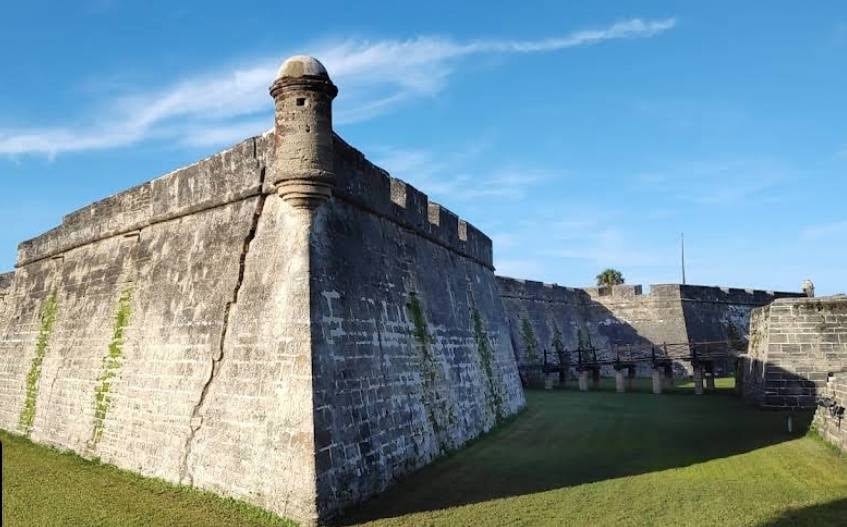 <p style="font-family:Tahoma,Arial,sans-serif;font-size:10px;">The historic coquina walls of Castillo de San Marcos in St. Augustine, Florida, viewed on a sunny mid-morning.</p> |
If the Castillo de San Marcos has become part of the scenery for you, try returning with a single question: why was this particular stone used to build a fortress? The answer offers a way to move beyond a familiar outline on the bayfront and notice the relationship between local materials and the work of building a defense.
The National Park Service's construction account identifies the material as coquina, a porous limestone. Its tiny air spaces helped the thick walls absorb or deflect cannon projectiles. A material that might initially seem a surprising choice for a fort turned out to have properties that helped the structure withstand attack.
Look for an explanation, not just an image
You do not need an engineering background to enjoy this part of the Castillo's story. Start by observing where interpretation points out the building material, then connect that explanation with the whole structure. The question is not simply what the walls are made of, but how a material and a design worked together.
Avoid handling historic surfaces or treating them as samples to test. A photograph, a museum explanation and a question for a ranger can offer a closer look while respecting the site. If you are discussing the story with children, use the National Park Service's explanation rather than improvising a demonstration that could damage the building.
Bring a different question each time
A seasoned resident might ask how construction choices were shaped by what was available locally. A new neighbor might start with the fort's place in the city's history. A visitor with limited time might decide that understanding one feature is more rewarding than trying to memorize a whole chronology in a single stop.
Those approaches are invitations, not fixed routes. The same landmark can serve different interests, and a return visit does not need to reproduce the first one. You may find that a smaller focus gives you more to talk about afterward than another collection of familiar photographs.
Notice the people behind the structure
Buildings do not appear by themselves. A thoughtful visit can include questions about the labor, skills and decisions involved in construction, not only the military purpose. Use reliable park interpretation to explore those topics, and avoid assuming that a neat architectural description captures every human story connected with the site.
If a detail raises a question you cannot answer during the visit, keep it for later reading. There is no need to force a complete explanation before leaving. A local history outing can be the beginning of a longer interest, especially for someone whose daily routine regularly passes the same landmark.
Plan the visit you actually want
Check the official park website for current opening information, admission, accessibility and alerts. Confirm any demonstration schedule separately instead of assuming it is included at your chosen time. Leave room for the parts of the experience that matter to your group, whether interpretation, architecture or a careful look at the exterior.
For our Monday trivia, coquina is a strong answer because it comes with an explanation readers can explore. If that question has already appeared in the week's newsletter, the full article should deepen the topic rather than present the same question as a new surprise.
|
 Coquina stone is the material was used to build the famous Castillo de San Marcos and other buildings in the Spanish colonial town of St. Augustine. |
Follow the stone back to the island
The US National Park Service (NPS) coquina account explains that shell fragments became bound into limestone and that the Castillo's stone was quarried around present-day Anastasia State Park. Construction began in 1672, and its first phase was completed in 1695. That connects the bayfront landmark with an island landscape you may know primarily for the beach. A future visit can explore that relationship without assuming a quarry and a finished fort look alike.
Give each place a distinct role in your thinking. At the Castillo, consider how the material was used in the completed defense. At a quarry interpretation, consider where it came from and the work needed to turn a local resource into a building supply. You don't need to visit both in the same afternoon. Two smaller outings can leave more room for observation and discussion than a single hurried route.
Notice how the shape answers a problem
The construction page describes the bastion system, including projecting angled formations developed in response to changing military technology. Look at the building's outline as part of its function, not merely an attractive shape for a photograph. Ask how the design helped defenders respond to threats. Let a diagram or ranger explanation guide that question rather than trying to infer an entire defensive strategy from one viewpoint.
You can use two different observations together: what the structure is made of and how it is arranged. One question concerns the material; the other concerns design. That makes a return visit more rewarding because you have something specific to notice beyond whether the landmark still looks familiar. If you sketch or photograph a feature, include a note about what the interpretation actually explained so your later account remains accurate.
Keep the human work in the picture
The NPS emphasizes the engineers, artisans, and laborers behind the Castillo. It is worth pausing when a building's endurance threatens to become the whole story. Who had the knowledge to shape the material? What work did construction require? What does the site's interpretation say about the people involved? These questions help prevent architectural description from making the workforce invisible or assuming every worker had the same circumstances.
The NPS workforce account adds an important dimension: Native people were compelled to work on the fort, alongside other laborers whose circumstances differed. Keep that history beside the engineering achievement. A surviving building can reflect remarkable skill while also raising difficult questions about power, labor, and whose experiences are remembered.
A better way to share a familiar landmark
When taking a guest to the Castillo, offer one question before you arrive rather than giving a long speech on the way. Invite them to notice a detail and bring it into the conversation afterward. Someone new to the city may want broad context, while a returning visitor may enjoy a narrow construction topic. You don't need to insist that everyone finds the same feature most interesting.
Our suggested small challenge is to leave... able to explain one connection: local stone and defense, island quarry and city landmark, or building shape and military purpose. Use the official links to check your account before posting it. Then tell us which detail made the place feel less like background scenery. Those discoveries can become future Coast & Home features about the materials, skills, and landscapes that shaped Saint Augustine.
What familiar Saint Augustine place made more sense after you learned one detail about it? Tell us what changed your perspective. The Castillo can remain a landmark you love while becoming a place you look at more closely the next time you pass.
|
Keep exploring with us
Which part of this local story deserves a closer look?
Talk soon,
Bill Marks
|
Quote Of The Day |
“The past is a foreign country: they do things differently there.”
— L. P. Hartley Commander of the Order of the British Empire, 1956 English novelist and short-story writer | (1895 -- 1972)
|
0 Comments
Join the conversation
Be the first to comment
Share your thoughts above.